
 Before a planned urine test, you are advised to avoid strenuous physical activity or long walks.
You are advised to avoid sexual intercourse for at least a day before collecting urine for testing.
Microscopic examination of urine sediment should not be performed around or during menstruation, and you should consider postponing the test during this time.
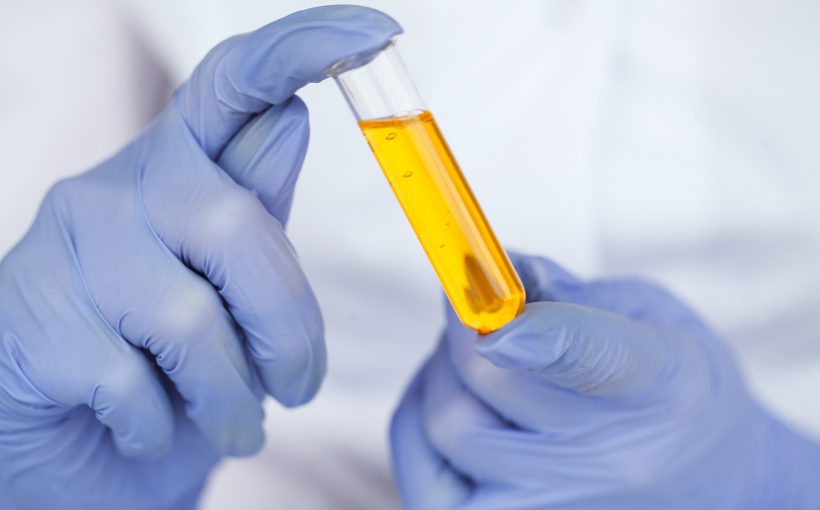
The patient should obtain a disposable urine collection container from a collection point. This container is usually also used to store and transport the sample to the laboratory.
For microbiological tests, the container must be sterile.
Before passing urine, thoroughly wash the area around the opening of the urethra (using soap and water). If the patient cannot pass urine into a container (e.g. a baby or a bedridden patient), urine should be collected in a special plastic bag fitted around the external opening of the urethra. These bags are available from pharmacies.
Urine is most commonly collected as a midstream sample during urination, although sometimes the first portion of urine passed is required, e.g. for detecting Chlamydia trachomatis.
Collecting a midstream urine sample:
Pass the first portion of urine into the toilet, then, without stopping the flow,
collect approximately 50 – 100 ml in the container prepared beforehand, and pass the final portion into the toilet.
Close the container holding the sample as soon as possible.
First morning urine sample
This is considered the standard sample for routine urinalysis. Before collection, the urine remains in the bladder for several hours
(usually 8 hours) overnight.
Second morning urine sample
Passed 2 – 4 hours after the first. It is more convenient for urgent testing, but its composition depends on fluid intake and physical activity before collection.
Random (spot) urine sample
Passed at any time of day, in any volume, without patient preparation. It is used for testing when an immediate clinical need arises.
24-hour urine collection
Collect urine in a dry, clean container that is large enough (approximately 2 – 2.5 l). Graduated containers are available from the laboratory or a pharmacy.
Start the collection in the morning (e.g. at 7.00) and finish at the same time the following day. Discard the first morning portion of urine (pass it into the toilet). Collect all subsequent portions in the prepared container, including the morning portion from the following day. Keep the urine container in a dark, cool place throughout the collection period. Once the collection is complete, measure and record the total volume of urine collected (in millilitres). Mix the urine, pour 30 – 50 ml into a urine sample container and take it to the laboratory.
Please note:
If, for any reason, even one portion of urine passed during the collection period is not transferred to the collection container, the test will not be accurate. In this case, repeat the urine collection on another day.
Detailed instructions for 24-hour urine collection requiring preservation with hydrochloric acid (HCl) are available
from the laboratory.
Handling the sample after collection
Take the collected urine to the laboratory as soon as possible. If the sample needs to be stored, it is best kept at refrigerator temperature.
You can have urine tests in many towns and cities in Poland, including Aleksandrów Łódzki near Łódź, Bełchatów, Bełżyce in the Lubelskie region, Bogatynia, Bychawa, Bydgoszcz, Cedry Wielkie, Chełm, Dąbrówka near Poznań, Drzewica Nowe Miasto near Pilica, Działdowo – Przygoda Żuromin, Garwolin, Gdańsk, Gdynia, Gliwice, Głogów, Goleniów, Gorzów Wielkopolski, Gorzyce near Wodzisław Śląski, Iłża, Jarosław near Rzeszów, Jelenia Góra, Koło, Kołobrzeg, Kostrzyn nad Odrą, Koszalin, Kościan near Poznań, Kościerzyna, Kwidzyn, Kraków (city centre and surrounding areas), Krzywiń near Poznań, Kutno near Łódź, Legionowo near Warszawa, Lesko near Sanok, Lidzbark Welski, Lublin, Łomża near Ostrołęka, Łowicz near Łódź, Łódź, Mielec, Mińsk Mazowiecki, Nowe Miasto nad Pilicą, Nowy Sącz, Oborniki Śląskie near Wrocław, Olsztyn, Opole, Ostrołęka, Otwock, Płońsk, Poddębice, Poznań, Prabuty, Pruszcz Gdański, Pułtusk, Raciąż near Płock, Racibórz near Wodzisław Śląski, Radom, Rogowiec near Bełchatów, Rybnik – Niedobczyce near Wodzisław Śląski, Rybnik – Niewiadom near Wodzisław Śląski, Rzeszów, Sanok, Siedlce, Sierpc, Skórzewo, Sochaczew, Sopot, Szczecin, Szydłowiec, Świecie, Tczew, Tuchola, Warszawa, Wodzisław Śląski, Wrocław, Wysokie Mazowieckie near Ostrołęka, Wejherowo, Ząbki, Zabrze near Wodzisław Śląski, Zambrów near Ostrołęka, Żuromin, Żychlin near Płock. BadamySie.pl
Where can I get blood tests without a referral?
Blood collection centres with addresses and opening hours: Warszawa · Wrocław · Łódź · Kraków · Poznań · Gdańsk · Szczecin · Bydgoszcz · all cities.
Order your tests online at BadamySie.pl and have them done at a centre of your choice.